

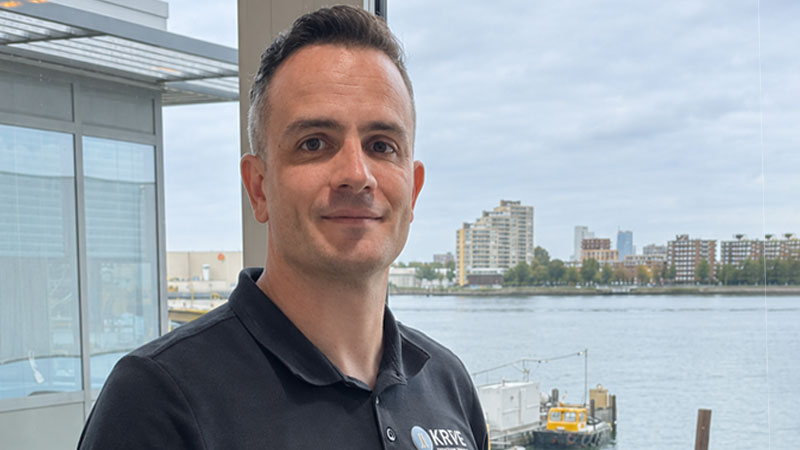
“We must keep maritime expertise and shipbuilding in Europe” Interview with Sjoerd van Maanen
Above all, this requires structural collaboration, better alignment of regulations and maintaining our strength in building complex vessels, including cruise ships,” says Sjoerd van Maanen, board member of KRVE (Koninklijke Roeiers Vereeniging Eendracht, Royal Boatmen’s Association Eendracht) and board member of employers’ organisation VNO-NCW Rotterdam Region, where he is responsible for the portfolio maritime (manufacturing) industry.
Why is the maritime manufacturing industry so important?
“A shipyard builds a vessel however, in line with this there is an entire maritime economy. I might be looking at this somewhat differently from someone working at a shipyard as I work in the Port of Rotterdam. Here you can clearly see that the maritime industry is much broader than shipbuilding alone. A vessel is supported by an extensive chain of expertise and services, including engineering, maintenance, repair, sustainability, ports, terminals and a wide range of specialised service providers. In my view, that’s expertise we should want to keep in Europe. Not only for economic reasons, yet also because we do not want to become entirely dependent on other parts of the world for our energy supply, infrastructure, defence and trade.”
Should one in Europe cooperate more closely in this regard?
“Absolutely! Shipping is, by definition, international. It is therefore somewhat strange that, while we all share the same sustainability ambitions in Europe, we then develop different requirements, procedures or technical solutions. I fully support high standards for safety and sustainability, but we should strive to align them across Europe as much as possible. That way, shipping companies know what to expect and the industry knows where to invest.”
Are we at risk of losing shipbuilding to Asia?
“For many standard commercial vessels, a large part of production has indeed shifted to Asia, that’s reality. However, Europe’s strength lies in expertise, complex (cruise) vessels, maritime technology, sustainability and specialised services. Those are also areas where I believe the Netherlands has significant opportunities. In essence Europe does not need to be the cheapest nevertheless, the best and safest.
Why are cruise ships so interesting in this context?
“One thing that struck me when I looked into this is that the European Commission states that 97% of the global cruise fleet is being built in Europe. We are talking about high-end European shipbuilding, engineering, interiors, sustainability, maintenance, repair and all the specialised companies involved. This means that the cruise sector is an important part of Europe’s maritime manufacturing industry.” The cruise sector is also under close scrutiny when it comes to sustainability.
What’s your view on this ?
“Cruise ships are enormous in sight and the sustainability challenge thereto significant. However, because Europe is so strong in building and maintaining these complex vessels, we also have the expertise needed to already implemented new technologies with more to come. It should be noted that the cruise sector has already made considerable progress in becoming sustainable. In short, if we want shipping in general to become cleaner, apart from regulations we need companies that can actually do the job and build the solutions.”
This is something we already see in Rotterdam, right?
“Absolutely! Take shore power, for example. Since 2025, cruise ships in Rotterdam have been able to connect to shore power at the Holland Amerika quay. To me, this is a good example of how things should work: Europe sets the direction, after which the port, terminal, grid operator, technology companies and the vessels themselves work together to make it happen in practice. This also demonstrates why standardisation is so important. In the future, a cruise ship should be able to connect in the same way to shore power in all European ports.”
In your opinion, what should be Europe’s priority?
“Set clear objectives, align regulations, give companies sufficient certainty to invest for the long term and take international competition into account. European companies should obviously meet high standards, but they must also be able to compete with companies outside Europe that operate under different conditions. We should definitely avoid creating a situation where our own regulations drives production out of Europe, only for us to import the same products again later on.”
Is European regulation more of a burden or an opportunity?
“We want to continue improving sustainability and maintain high safety standards, so clear rules are essential. The problem arises when regulations do not align, change constantly or are interpreted differently from one country to another. Effective European regulation can actually be an advantage: one large market, a common set of principles and, as a result, sufficient scale for companies to invest.”
What message would you like to give Brussels?
“Europe has outstanding maritime expertise, shipyards, suppliers, ports, terminals and people, so let’s value what we have. We do not need to manufacture everything ourselves however, when it comes to strategic maritime technology and expertise, we must avoid becoming dependent on others. Provide clarity for companies, ensure a level playing field and make the most of Europe’s scale. That way, sustainability and economic growth will go hand in hand.”